How to make Facebook auto replies sound like you
A reply sounds like you when it uses your words and your facts, and when it stops. Tone settings do not fix a missing price.
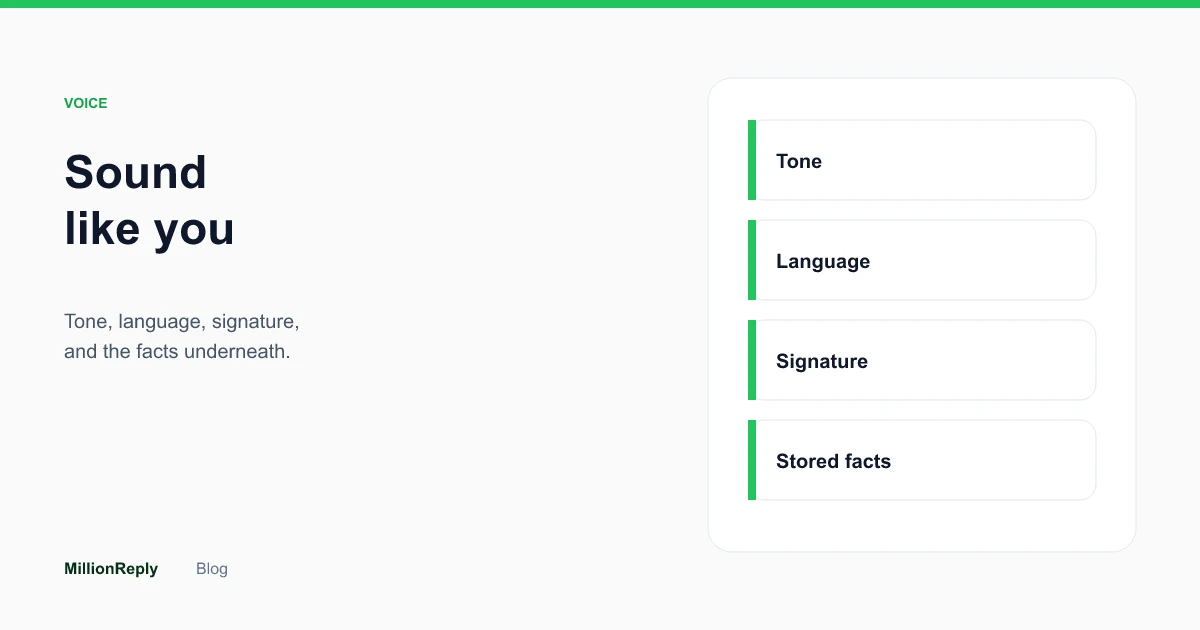
A Facebook auto reply sounds like you when a regular customer could not tell you had help, and when the facts in it are facts you would swear to. It does not sound like you because a setting said “friendly.” Friendly is not a voice. Your voice is the length you write, the words you skip, and the limits you state without apologizing.
MillionReply splits this into a persona and a knowledge base. The persona is tone, language, and an optional signature. The knowledge is what you are willing to say is true. If you only set the persona, you will get pleasant guesses. Set both, then read drafts before you change the send mode. The order of setup is in how to set up Messenger auto reply.
Voice is a few concrete choices
Tone in the product is casual, professional, or fun. Pick from messages you have already sent, not from a brand deck.
Casual fits if you write “yeah, Thursday works” and you use contractions. Professional fits if you write full sentences and you do not joke about the booking. Fun fits if you actually joke. It does not fit because you wish you seemed warmer. Warmth you do not use in real chats will show up as decoration.
Language is the language you answer in. If you reply to customers in English, set English. Do not set a second language “just in case” and hope the reply code-switches the way you do. If you truly answer some people in another language, decide that on purpose, and check those drafts with extra care.
The signature is optional. Use it when your real messages already end with a name and a business. Skip it when they end when the answer ends. An example of a signature that matches a real habit: “Sam, Northside Plumbing.” An example of one that does not: a slogan you have never typed in Messenger.
You can keep more than one persona if you truly talk in two registers, and point a rule at the one a thread should use. Most people need one. A second persona for “angry customers” often becomes a script that still should have been a human takeover.
Facts do more for the voice than adjectives do
Read two replies to “how much?”:
“Happy to help. Pricing depends on a few factors. Let me know what you’re looking for and I’ll be glad to walk you through options.”
“Leak visits are $80 in the north side, waived if we do the repair. I can’t price the repair from a photo.”
The first one has a friendly tone and no voice, because it could be anyone. The second one is a specific person, even if the tone setting is plain. Specificity is the sound. Adjectives are not.
That is why knowledge has its own guide: what to teach an AI before it answers Facebook messages. Put the numbers, the hours, the suburbs, and the refusals there. Then tell the persona, in plain instructions, to stay short and to avoid saying anything that is not in those notes. If you cannot bear a missing fact, the mode should be draft, so you supply it. Do not ask the voice to improvise a price in a pleasant register.
Rules are how you freeze a line that must not be paraphrased. “Weekend rate is $60” can be a rule if it never changes. A rule that says “be helpful” is not a rule. It is a wish, and wishes get paraphrased into filler.
Phrases that make a reply feel assembled
You will see these even when the facts are right. Delete the pattern, not just one draft.
A greeting bigger than the answer. “Thanks so much for reaching out.” You might thank a person in real life. You probably do not open every Messenger reply that way. If your real opens are “Hey” or nothing, the drafts should match.
A fake menu of help. “I can help with pricing, availability, or booking.” They already asked. Answer that.
Restating the question. “So you’re looking for a Saturday lesson.” They know. Get to the slot.
Stacking questions. Three questions back feels like a form. One question is a conversation. Zero is fine if you already have what you need.
Apology for existing. “Sorry for the delay” when the delay was a minute. “Sorry” when you are simply closed. Say you are closed and when you are back.
Soft claims you would never insure. “We’d love to make this work.” “Absolutely.” “No problem at all” in front of a limit. If the limit is real, state the limit. The cheer is what makes it feel canned.
Emoji you do not use. If you never send them, the reply should not.
Exclamation marks you do not use. Same test. Read your last twenty real messages. Match the punctuation, not the punctuation of a brochure.
An example of a draft before the cut: “Hi there. Thanks for your message. We’d be happy to help with a Saturday lesson. What age is the student, what subject, and do you prefer morning or afternoon?”
The same fact after the cut, as an example: “Saturday morning is open, 9 to 12. A lesson is $40. What subject?”
You would send the second one. You would edit the first one every time. So the first one is not your voice, no matter which tone created it.
Borrow from messages you already sent
Paste five real replies you were proud of into a note, next to the persona, as examples of length and wording. Not as testimonials. As patterns.
Notice the length. If you write two sentences, a draft that writes eight is wrong even when every sentence is true. Say you want short replies. Then enforce it by editing drafts until the setup complies, or by using a rule for the replies that keep running long.
Notice the no. Your real messages decline clearly. “I don’t do Sundays.” Drafts often decline sideways. “Sundays can be tricky, but let me see what I can do.” If you do not see what you can do, that sentence is a lie in a soft voice. Put the decline in the facts: “I do not work Sundays. Do not offer Sunday.”
Notice names. If you use the person’s name only when you know them, do not have every reply start with a name pulled from the profile. It reads as mail merge. If you always use the name, then it is fine.
Length, names, and the words you never type
Collect a private list from your real chats. Not for the customer. For you.
Words you use: the greeting, if any, the way you say no, the way you say a price. Words you never use: “absolutely,” “circle back,” “kindly,” “team,” if there is no team. Put the never-list in the persona note as a ban, in plain language. “Do not say absolutely. Do not say team. Do not start with thanks for reaching out.”
Length is a ban too. “Two short sentences unless I ask a question, and then three.” You will still get a long draft sometimes. Shorten the note and try again. If you only shorten the sent message, the next one grows back.
Names are a tell when they are wrong. A profile name is not always what you call someone. If you would say “Sam” and the draft says “Samantha,” it feels like a letter. Prefer no name over the wrong one. If your real habit is no name, say so.
Punctuation is part of the same list. A person who never uses an exclamation mark should not grow one because a tone was set to fun. A person who writes in lowercase still might not want the reply to do that, because lowercase-as-a-style often looks like a costume. Match the real messages, including the boring ones, not the one message where you were being charming.
Emoji follow the same rule. If the last month of chats has none, the reply has none. One emoji you do use, used where you use it, is fine. A sprinkle is a brochure.
Two registers, if you truly have them
Some people write one way to new buyers and another way to clients they have known for years. If that difference is real, two personas can be honest. The new-buyer one is shorter and states the price. The regular one assumes the price and talks about the date. A rule can point a thread at a persona. If you cannot explain the rule in a sentence (“Marketplace uses the short one”), you do not have two registers. You have a mood. Moods should not be settings.
Do not build a third persona for complaints. Complaints are a hand-back. The right voice for a complaint is yours, typed after you have read it, not a “empathetic” preset that apologizes for things you have not agreed to fix. Take the thread over. Empathy you did not mean is how small businesses end up promising refunds.
The same goes for a “sales” persona that is pushier than you are. If you would not add “want me to lock that in?” you should not let a persona add it. Pushiness is easy for a draft to invent because it looks like helpfulness. Ban the nudge unless it is a sentence you send every day.
Read ten drafts before you change the mode
Draft mode is the editing desk. Auto mode is publishing. Do not publish to discover the voice.
Take ten real incoming messages. Read each draft next to a reply you sent last month for a similar question. Mark only the differences you would not let stand: a fact, a filler phrase, a question too many, a signature you would not have added.
Fix the setup, not the single draft, when the same difference appears twice. Add the fact. Ban the phrase in the persona note. Remove the signature. Then run another message. Editing the outgoing text and leaving the setup untouched means the eleventh reply will repeat the problem, especially if you later turn on auto or hybrid.
Ask one other person who knows how you write, if you have one, to read three drafts blind. If they say “this isn’t you” and point at a sentence, believe them. You are too close to the facts to hear the padding.
When ten drafts in a row are ones you would send unchanged, the voice is done enough. It will still drift when a weird question arrives. That is what takeover is for. You step in, the AI stays out of that thread, and the ordinary questions keep using the voice you already checked.
A worked pass, as an example
A baker who takes cake orders in Messenger types like this in real life: short, no emoji, prices up front, no Sunday work.
She sets professional, not fun. She skips the signature. She stores: “Standard cakes start at $70. I need two weeks. I don’t do gluten-free. I don’t do Sundays. Custom shapes need a photo and I will reply myself.”
The first draft to “how much for a birthday cake” offers gluten-free as an option and asks about flavors, filling, and candles. She adds “do not offer gluten-free” and “ask one question at most.” The next draft says cakes start at $70, she needs two weeks, and asks the date. She would send that. She stays on draft until a week of those look the same.
That is the whole craft. Match the register you already have. Put the limits where a reply cannot miss them. Cut the sentences you keep deleting. Then, and only then, decide whether anything sends without you.
Questions people ask
Which tone should I pick?
Should replies include a signature?
Why do drafts sound generic even with the right tone?
How do I know it sounds like me?
Keep reading
- How to set up auto reply on Facebook Messenger Connect Facebook, add your voice and a few facts, then pick draft, auto, or hybrid. Setup is about five minutes if the facts are ready.
- What to teach an AI before it answers Facebook messages Store prices, hours, availability, and the questions you will answer yourself. A reply can only be as true as the note you gave it.
- Draft, auto, or hybrid for Facebook messages Use draft when a wrong reply is expensive, hybrid when only the first message repeats, and auto after the drafts already sound like you.