What to teach an AI before it answers Facebook messages
Tone does not contain a price. Before any reply sends, write the facts a slightly tired version of you would still get right.
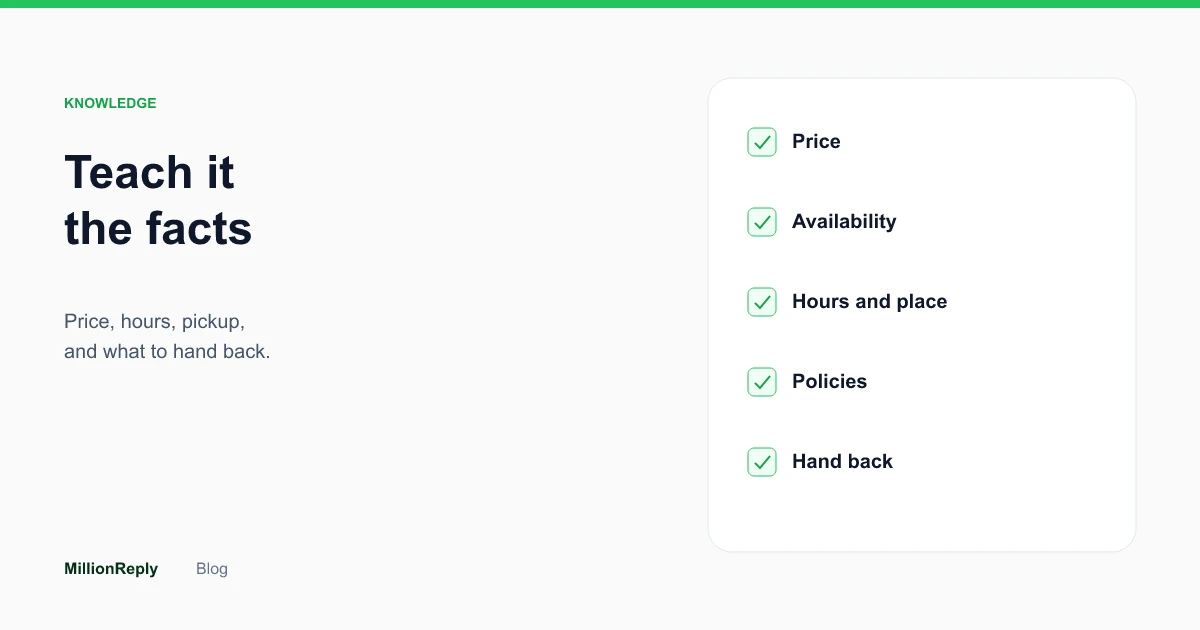
An AI reply to a Facebook message can only repeat, combine, or refuse what you stored. It cannot know that Thursday filled up after lunch, that the table sold, or that you never ship to the next state. If the note is silent, a fluent reply will often speak anyway. Teaching it is the work of writing the silences down as clearly as the prices.
Do this before you leave draft mode. The voice settings are a smaller job, and they are covered in how to make the replies sound like you. Setup order is in how to set up Messenger auto reply. This page is the contents of the note.
The reply knows your notes, not your week
Think of the knowledge as the card you would hand a new hire on Monday, except the hire never taps you on the shoulder. Anything not on the card is something they will invent or something you must answer yourself. You want the second outcome. You get it by listing the hand-backs, not by hoping.
Write in the words you would send. “Call-out is $80” beats “pricing is competitive and depends on scope.” The second sentence is true of every business and useful to none of them. Short lines are easier to check six weeks later when you have forgotten what you meant.
Separate facts from tone. A persona set to casual does not include your suburb. Knowledge does. Rules are a third bucket: a line that must go out word for word, matched by keyword or intent, in an order you set. Use a rule for a rate that must not be paraphrased. Use knowledge for everything else a reply might need to draw on. Do not dump a slogan into either and call it training.
Prices and availability
Write the number you will actually honor. If there are two numbers, write the condition in the same line. “Lessons are $40. The first trial lesson is $20.” If you do not discount, write “Do not offer a lower price.” That sentence prevents a helpful draft from negotiating.
Availability needs a status and a habit for changing it. For a service, the habit might be “this week’s open days are Tuesday and Thursday evenings. If they ask about another day, say you will check.” For a Marketplace listing, the habit might be “do not say an item is available unless this note names it. Otherwise say you will confirm.” The listing version is stricter because a false yes sends a person to a doorway. More of that inbox is in Facebook Marketplace auto reply.
Include what is sold out or fully booked when that state lasts more than a day. Delete it when it stops being true. A note that says “Thursday is full” into the next month will keep turning Thursday away.
If you have many prices, do not paste a whole catalog and assume the right line will be chosen. Group them. “Haircuts $35, color from $90, I will quote color myself.” The last clause is a hand-back. It is more valuable than a fake precise quote.
Hours, place, and how someone reaches you
Hours are not a personality. “Weekdays 9 to 5, Saturday 9 to 1, Sunday closed. Timezone: …” Write the timezone. A “9am” without a place is how two people miss each other.
Write where the work happens, at the level you are willing to auto-send. Suburb and meeting point, not your home address, unless you already send your home address to anyone who asks. If the exact address comes after you trust the person, say that: “Share the suburb only. I will send the address myself once the time is confirmed.”
If you want a different sentence at night, that is business hours plus an off-hours reply, not a second copy of your whole price list. The closed line is its own small note. Keep it consistent with the hours above so you are not “open until 6” in one place and “closed after 5” in another.
Phone numbers and emails belong here only if you want them in a Facebook reply. Many people should not. “Keep the conversation in Messenger until I move it” is a valid fact.
Policies you are tired of retyping
Deposits, refunds, holds, shipping, cancellations, lateness. One line each. The line you have typed a hundred times is the line worth storing, because it is stable.
Examples of the shape, labeled as examples, not as advice for your trade:
“I don’t hold Marketplace items without a confirmed pickup time.”
“Lessons cancelled with less than 12 hours’ notice are still charged.”
“I don’t ship. Pickup only.”
“Quotes from photos are not final. I have to see the job.”
If you do not have a policy yet, do not invent one to fill the box. “I will decide case by case, so do not state a rule” is the honest note. Those threads stay with you. A made-up refund policy that sounds official is worse than silence, because people will hold you to it.
Questions that should come back to you
List them as refusals. The reply is better at following a refusal than at sensing danger.
Custom quotes. Complaints. Refund exceptions. Anything medical, legal, or about a child’s safety. Hiring and procurement forms. “Can you do it cheaper if I pay cash.” Bundles you have not priced. A request to pretend an item is new.
Write the refusal as an action. “If they ask for a repair price from a photo, say you need to see it and do not give a number.” “If they are upset, do not apologize on my behalf or offer a refund. Stop and leave the thread for me.”
Then match the mode to the refusal. If these messages are common, draft or hybrid will catch them as follow-ups. Auto plus a vague refusal will sometimes barrel through. The mode page is draft, auto, or hybrid. Human takeover is the manual version: you mark the thread, and the AI stays out.
Also list who is out of scope entirely. Friends, if you turned on skip friends. People you blocked. Threads you never enabled. You do not need a paragraph of knowledge for them. You need them left out.
How to write a snippet so it gets used
Name it for the question, not for your feelings. “Saturday lessons” beats “tone of voice notes.”
Keep it under a short paragraph. If you need a page, you have several policies mashed together. Split them. A reply can follow a short rule. A page becomes a brochure, and brochures leak into the message as padding.
One fact per line where you can. “Standard cake from $70. Two weeks’ notice. No gluten-free. No Sundays.” You can scan that in a month and see the stale bit.
Date the volatile bits in the text. “Open slots for the week of 28 September: Tuesday, Thursday.” When the week changes, the date embarrasses you into editing it. An undated “Tuesday and Thursday” quietly becomes folklore.
Do not include instructions like “sound warm and human.” That belongs in the persona, and even there it is weaker than examples of your real length. Facts should be checkable. If you cannot point to the sentence and say “that is true today,” it does not belong in the note.
Two cards, as examples
A tutor’s card:
“Weeknight lessons 6pm to 8pm. Saturday 9am to 12pm. $40 a lesson, $20 for the first trial. I teach high school maths only. I don’t teach primary. I don’t do Sundays. If they want a package price, I will reply myself. Suburb: I travel within 20 minutes of Newtown, and I say the suburb, not my address.”
A Marketplace card for the same person, who is also selling a spare desk, kept separate:
“Desk is $70 until I mark this line sold. Pickup Saturday morning, Newtown, public meeting point. I don’t ship. I don’t hold it. If they ask about scratches, I will answer myself. Do not talk about tutoring in this inbox.”
The split is the point. One brain can hold both notes. One reply should not offer a maths lesson to a desk buyer, and it should not quote the desk to a parent. If your drafts cross the streams, the notes are too blended, or both inboxes are on with no distinction in the text. Name the inbox in the note if you have to. “This fact is for Marketplace only.”
Test each card with a message you have already answered. If the draft adds a service the card does not mention, add a refusal. If it omits the price, the price is too buried. A card that only works when you reread it to the software is not done.
Read drafts for facts the note forgot, not for style, on this pass. Style has its own edit. A missing suburb will hurt someone this week. An extra “happy to help” is only irritating. Fix the suburb first.
If you sell and you book, keep the two cards in separate snippets with boring names. “Marketplace pickup” and “Lesson times.” You should be able to find the stale line without reading your whole business back to yourself.
How you know a line is stale
Read the note every time you would be angry to see it sent. That is a better schedule than “every Monday,” which you will skip.
Stale looks like this: a day you are fully booked that is still listed as open. A product that sold. A suburb you left. A deposit amount you changed in conversation and not in the snippet. A seasonal line (“I have Christmas cakes”) still sitting in March.
The check takes five minutes if the note is short. If the check takes half an hour, the note is a document, and documents do not get maintained. Cut it back to the lines a reply actually used in the last week. You can see those lines. They are in the drafts you sent. Anything you never sent is a candidate to delete.
When you edit, edit the rule and the knowledge if both mention the number. Then send one draft to yourself, or approve the next real one with extra attention. The first reply after a price change is the one that still has the old number if you missed a copy.
When the business changes
Change the note first, then tell the public. The other order produces one wrong reply, which is how you discover the old sentence was still live.
Sold the item: update the Marketplace note or pause those threads before you celebrate. Raised the rate: change the number in knowledge and in any rule that hard-codes it. A rule will keep shouting the old number, correctly and forever. Away next week: either say so in the hours, switch the inbox off, or write an off-hours style line for the whole week. Do not leave “I can do Thursday” running while you are on a train.
Read the note on the same day you change a listing or a price. It takes less time than the argument with the person who believed the draft.
If you are starting from an empty box, write five lines today: the main price, the hours, the place, one policy you repeat, and one refusal. Turn on draft. Let real questions show you the sixth line. That is enough to begin. A complete manual you never finish is not.
Questions people ask
What if I do not know every answer yet?
Where do prices go, the persona or the knowledge?
How often should I update the notes?
Can one note cover Messenger and Marketplace?
Keep reading
- How to set up auto reply on Facebook Messenger Connect Facebook, add your voice and a few facts, then pick draft, auto, or hybrid. Setup is about five minutes if the facts are ready.
- Facebook Marketplace auto reply for "is this still available?" Answer availability, price, and pickup from facts you stored. Keep Marketplace on its own reply mode, and do not let a draft invent a discount.
- How to make Facebook auto replies sound like you Set a tone you already use, store the facts separately, and cut the filler. Read ten drafts before you let any reply send on its own.